ConcreteTech is our collection of articles exploring the technology, materials, and best practices behind concrete construction.
Blisters on Concrete Slabs
Blisters are hollow, low-profile bumps on a concrete slab surface, that can range in size from ¼ to 4 inch in diameter with a dense skin of mortar about ⅛ inch thick covering an underlying void.
Hot Weather Concreting
Hot weather should be taken into consideration when planning concrete projects because of the potential effects on fresh and newly placed concrete.
Delamination of Troweled Concrete Surfaces
Delaminations are separations of thin layers of the slab surface from the base concrete.
Cold Weather Concreting
Successful cold-weather concreting requires an understanding of the various factors that affect concrete properties.
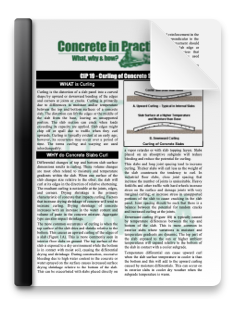
Curling of Concrete Slabs
Curling is the distortion of a slab panel into a curved shape by upward or downward bending of the edges and corners at joints or cracks.
Scaling Concrete Surfaces
Scaling is local flaking or peeling of a finished surface of hardened concrete as a result of exposure to cycles of freezing and thawing.
Cracks in Residential Basement Walls
Cast-in-place concrete basements provide durable,high quality living space. Some cracking is normal in concrete basement walls.
Plastic Shrinkage
Plastic shrinkage cracks appear in the surface of fresh concrete soon after it is placed and while it is still plastic.
Curing In-Place Concrete
External curing is a step during construction that involves maintaining newly placed concrete at adequate moisture and temperature conditions so that it can develop properties, such as strength and durability, that the mixture was designed to achieve.
Crazing Concrete Surfaces
Crazing is the development of a network of fine random cracks or fissures on the surface of concrete or mortar caused by shrinkage of the surface layer that is rich in paste or mortar.
Cracking Concrete
Concrete, like other construction materials, contracts and expands with changes in moisture and temperature, and deflects depending on load and support conditions.
Finishing Concrete Flatwork
Finishing is the operation of creating a concrete surface of a desired texture, smoothness, and durability. The finish on a concrete slab can be functional or decorative.
Dusting Concrete
Formation of loose powder resulting from disintegration of surface of hardened concrete is called dusting or chalking.
Synthetic Fibers for Concrete
Synthetic fibers engineered for use in concrete can withstand the long-term alkaline environment of concrete.
Joints in Concrete Slabs on Grade
Concrete expands and shrinks with changes in moisture and temperature. The overall tendency is to shrink and this can cause cracking at an early age.